Comparison · India
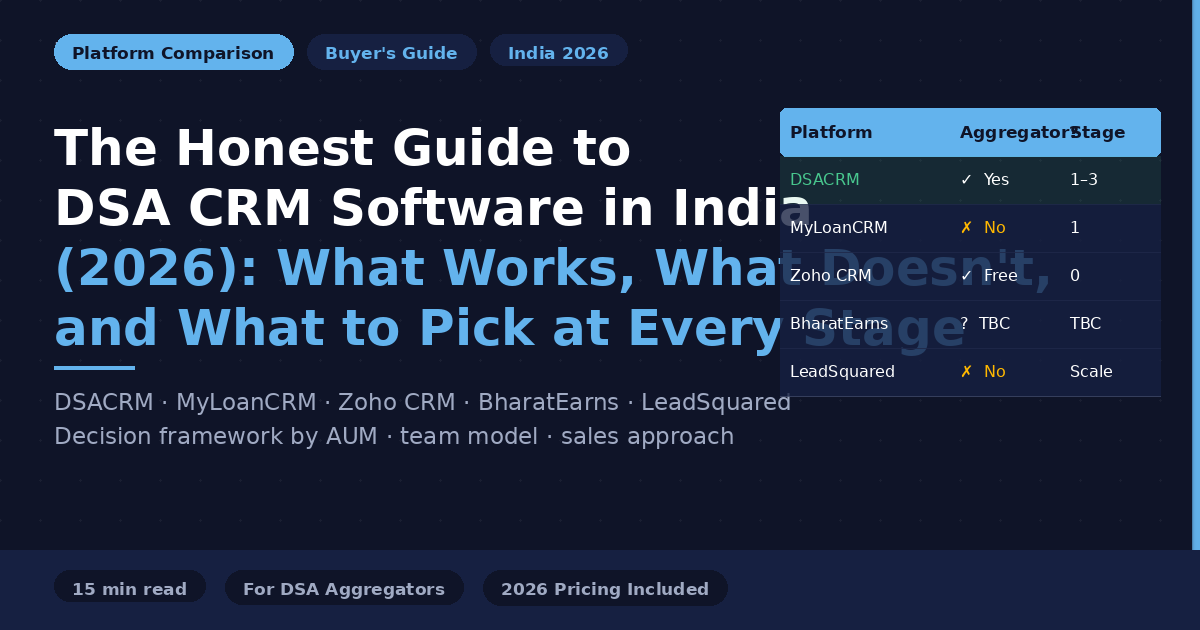
The Honest Guide to DSA CRM Software in India (2026): What Works, What Doesn't, and What to Pick at Every Stage
- TL;DR
- For most DSA aggregators in India in 2026, DSACRM is the top pick — it has a separate partner portal, unlimited users in the Professional plan, UTM and QR codes per connector, commission tracking, soft pull bureau integration, and a built-in Bank Rules Engine. For small inhouse teams under 20 agents, MyLoanCRM at under ₹1,500/month is the simpler option. For zero-budget starts, Zoho CRM free is the right bridge. Never use a CRM that counts partners as paying users.
We spent several weeks actually demoing, trialling, and getting full pricing proposals from every major DSA CRM in the Indian market. This guide covers what each platform is genuinely good for, where they break down, and a clear decision framework — by monthly AUM, team model, and sales approach — so you can pick the right tool without wasting months on the wrong one. We also cover the full DSA digital setup stack: WhatsApp, signing, KYC, and the complete onboarding workflow.
Why Most DSA CRM Guides Get It Wrong
The biggest mistake DSA businesses make when evaluating CRM software is treating all DSA operations as the same. They're not. There's a fundamental difference between a small inhouse team of 5–10 loan officers who originate loans themselves, and a DSA aggregator who has built a network of partner agents who submit leads independently. These two business models have completely different CRM requirements. A tool that's perfect for one is a disaster for the other — and most reviews online don't draw this distinction at all.
Similarly, a digital-first operation (where leads come through WhatsApp, website forms, and online ads) has different automation and integration needs compared to an agent-first operation (where field agents are the primary channel and the CRM primarily handles follow-up and documentation). We'll address all of this below.
The Platforms We Evaluated
Five platforms were evaluated for this guide across the Indian market in 2026: DSACRM (dsacrm.com) — purpose-built DSA CRM, suitable for inhouse and aggregator operations, starting at ₹2,999/month. MyLoanCRM (myloancrm.com) — traditional loan DSA CRM, suitable for small inhouse teams, under ₹1,500/month for up to 20 agents. Zoho CRM (zoho.com/crm) — general-purpose CRM, free for up to 3 users, suitable as a zero-cost starting point. BharatEarns (bharatearns.com) — AI-powered DSA CRM concept, unproven at this stage. LeadSquared (leadsquared.com) — enterprise marketing and sales CRM for digital-first loan businesses, ₹30,000–₹1,00,000+/month.
DSACRM — Top Pick for Most DSA Operations
DSACRM is purpose-built for India's loan distribution ecosystem. It handles the full DSA workflow out of the box without requiring extensive configuration.
What it does well
The partner portal is completely separate from the internal user interface — partners never become users in the traditional sense, which is critical for aggregator models. Each connector receives a unique UTM link and QR code at onboarding for precise lead source attribution. Commission tracking and payout management are built in. WhatsApp, email, and SMS automation runs via an N8N-style workflow engine. Leaderboards and incentive tracking keep partner networks engaged. KYC APIs (Aadhaar, PAN, GST, ITR), bureau integrations for soft pull credit checks, and a built-in Bank/NBFC Rules Engine (BRE) for automated lender matching are all included. 20+ APIs are included across all plans.
Pricing (2026)
Starter plan: ₹2,999/month (₹29,999/year) — 5 employees + 5 connectors. Professional plan: ₹5,999/month (₹59,999/year) — unlimited users. Enterprise plan: custom pricing — unlimited users + full white-labelling, all integrations, complete customisation. The Enterprise plan is worth a separate mention: if you're building a branded partner portal under your own domain, this is the path.
Who it's for
Any DSA aggregator from day one. Also excellent for growing inhouse operations that need automation and scale. Honest caveat: at ₹2,999/month minimum, it's not free — so if you're truly in month one with zero revenue, start on Zoho CRM and migrate to DSACRM once you have your first few partners active.
MyLoanCRM — Good for Small Inhouse Teams
MyLoanCRM is a traditional DSA CRM that's been around for a while. It's clear on what it is and what it isn't.
What works
Under ₹1,500/month for up to 20 agents — genuinely affordable for a small team. Simple interface, easy to learn, low implementation overhead. Bureau integrations built in: CIBIL soft pull at ₹100/fetch, Experian/CRIF at ₹40/fetch. Well-suited for traditional loan officers managing a pipeline manually.
Where it breaks down
Every partner is counted as a user — ₹250/user/month after the first 20. For an aggregator with 100 partners, that's ₹25,000/month in CRM fees alone, before earning a single commission. APIs are limited to enquiry management and bureau fetches only — no workflow automation, no partner portals, no commission tracking, no BRE. Not suited to WhatsApp-first or digital-first operations.
Who it's for
Small inhouse DSA teams (up to ~20 loan officers) where simplicity and low cost matter more than scale. Not suitable for aggregator models.
Zoho CRM — The Zero-Cost Starting Point
Zoho CRM is not built for DSA operations, but it's free for up to 3 users and extremely configurable. If you're already in the Zoho ecosystem (Zoho Mail, Zoho Books), starting here costs nothing.
What works
Free forever for up to 3 internal users. Partners are not users — you manage them as contacts/leads, not paying seats. 400+ integrations, connects with your website via API or Zoho Flow. Single login across Zoho Mail, Books, and CRM. Fully customisable pipelines.
What requires work
Zero loan-specific features out of the box — you build the pipelines manually. No commission tracking, no lender integrations, no WhatsApp automation, no soft pull bureau integration, no BRE. Configuration investment upfront for DSA-specific workflows.
Who it's for
Bootstrapped operations in their first 2–3 months, or anyone who needs to start immediately with zero budget. Use Zoho CRM to manage your first 20–30 partner leads while evaluating purpose-built tools. When operations stabilise, migrate to DSACRM.
BharatEarns — Interesting Concept, Unproven Product
BharatEarns markets itself as 'India's First AI-Powered DSA CRM' with WhatsApp automation, AI lending agents, and 70+ bank/NBFC connections. The feature set sounds compelling — AI lead distribution, automated calling, separate customer and partner portals. At the time of our evaluation however, BharatEarns had very few active users and limited verifiable customer references. The product appears to be early-stage and we couldn't verify depth of implementation. We'd revisit BharatEarns in 12–18 months once there's more production usage to reference.
LeadSquared — Marketing CRM for Digital-First Loan Businesses
LeadSquared is used by Godrej Housing Finance, LIC Housing Finance, and Poonawalla Fincorp. It's an enterprise-grade marketing and sales automation CRM — particularly strong for BFSI businesses that run paid digital marketing campaigns and need sophisticated lead nurturing, drip sequences, and marketing attribution.
Where it genuinely excels
If your loan business generates a high volume of inbound digital leads and your team's primary work is lead nurturing, follow-up sequencing, and marketing funnel optimisation — LeadSquared's marketing automation is best-in-class for Indian BFSI. The lead scoring, automated drip workflows, and marketing analytics are significantly more powerful than anything a DSA-specific CRM offers.
Why most DSAs should not start here
Enterprise pricing (₹30,000–₹1,00,000+/month) and 2–4 month implementation timelines. Built primarily as a marketing CRM — commission tracking, partner portals, soft pull integrations, BRE, and DSA-specific workflows are not its strength. Overkill for a relationship-driven or agent-first operation.
The Decision Framework: Pick Your CRM by Stage and Model
The Three-Stage Upgrade Path
Stage 1 — Getting started (under 30 partners / under ₹10 Lakh AUM): Zoho CRM free for digital-first inhouse operations; MyLoanCRM (under ₹1,500/month) for traditional inhouse teams of up to 20 agents. These are the entry-level tools to validate the model before committing to purpose-built software.
Stage 2 — Growing aggregator (30–200 partners / ₹10 Lakh – ₹1 Crore AUM): DSACRM Professional (₹5,999/month, unlimited users). This is the right tool once you have consistent revenue and the manual coordination overhead is becoming visible. UTM attribution, soft pull + BRE integration, WhatsApp automation, and commission tracking all earn their keep here.
Stage 3 — Established aggregator or digital-led scale (200+ partners / ₹1 Crore+ AUM): DSACRM Enterprise (custom pricing, full white-labelling) for aggregators building a branded partner experience. LeadSquared for digital-first loan businesses with heavy paid acquisition and a dedicated marketing team. Custom build for operations at ₹50 Crore+ monthly who need custom lender integrations.
Non-negotiable requirements for aggregators at any stage
Never use a CRM where partners are counted as paid users. At 100 partners, per-user pricing destroys your unit economics. The non-negotiables for any aggregator CRM: partner portal separate from internal CRM, flat or unlimited user pricing, UTM and QR codes per connector for lead attribution, commission tracking without manual work, soft pull bureau integration for pre-submission eligibility, and a BRE for automated lender matching.
The Full DSA Setup Stack (Beyond the CRM)
Most DSA businesses focus entirely on picking a CRM and forget that the CRM is only one piece of the operational setup. Here's the complete stack for a lean, well-run DSA operation.
WhatsApp Business: two numbers, not one
The biggest structural mistake DSA businesses make with WhatsApp is using a single number for everything. Your partners and your loan customers have completely different needs. The right setup is two dedicated WhatsApp Business numbers — one for partner acquisition and onboarding, one for customer loan inquiries and document collection. For Phase 1 (under 50 partners), the standard WhatsApp Business app is sufficient. Once you cross 50 active partners, connect to Wati.io (₹1,500/month) for broadcast messaging, automated sequences, and templated responses.
CRM pipelines: set these up on day one
Configure two separate pipelines from the start. Partner Pipeline: New Lead → Contacted → Documents Collected → Agreement Sent → Onboarded → Active Partner. Customer Pipeline: New Inquiry → Qualified → Soft Pull Check → Lender Matched (BRE) → Documents to Bank → Approved → Disbursed → Commission Received. The Commission Received stage closes the loop — it's how you know which partner sourced which loan and what you owe them.
Digital signing: Aadhaar eSign, not a click-through
Every partner must sign a DSA agreement before submitting their first lead. Aadhaar eSign is the right choice — the partner's identity is verified by UIDAI at the moment of signing, which is legally valid under Section 3A of the IT Act 2000 and makes commission disputes significantly harder to raise later. SignSetu (signsetu.in) at ₹15/signature is the simplest option for early-stage; Leegality (leegality.com) at ₹25/signature adds BharatStamp digital stamp paper for states where DSA agreements require stamp duty. Cost for first 100 partners: ₹1,500 total.
KYC collection: Google Drive is enough to start
For Phase 1, have partners send PAN and Aadhaar photos to the Partner WhatsApp number. Your team saves them to Google Drive in a folder named by Partner ID. Zero cost, works with how most agents communicate. When you're onboarding 20+ partners per month, upgrade to Digio for video KYC — Aadhaar verification, DigiLocker document pull, and liveness checks in a single flow.
Partner onboarding workflow
1. Partner registers via the CRM registration portal → CRM lead automatically created. 2. Team verifies basic details → lead moved to 'Agreement Sent' stage. 3. SignSetu link sent via WhatsApp → partner signs with Aadhaar OTP in 2 minutes. 4. Team requests PAN and Aadhaar photo → saved to Drive under partner's folder. 5. CRM updated to 'Onboarded' → partner receives their unique UTM link and QR code → added to team WhatsApp group.
Customer loan inquiry workflow
1. Customer submits via website form or messages Customer WhatsApp number. 2. Team follows up within the hour. 3. Soft pull credit check run inside CRM to determine eligibility. 4. BRE surfaces the best-fit lenders for this borrower's profile. 5. Documents collected and submitted to matched lenders. 6. Customer kept updated at each stage. 7. Commission recorded in CRM on disbursal — closes the partner attribution loop.
Our Recommendation in One Line per Stage
Zero revenue, just starting: Zoho CRM (free). Small inhouse team, up to 20 agents: MyLoanCRM (under ₹1,500/month). First aggregator (1–50 partners): DSACRM Starter (₹2,999/month). Growing aggregator (50–200 partners): DSACRM Professional (₹5,999/month). Established aggregator, white-label needed: DSACRM Enterprise (custom pricing). Digital marketing-led loan business, high inbound volume: LeadSquared (marketing CRM).
The Bottom Line
The Indian DSA CRM market is still maturing. The right choice depends entirely on your business model, team structure, and where you are in your growth journey. The single most important rule: never pick a CRM where your partners are counted as paying users. That decision alone ruins the economics of an aggregator model.
For most DSA aggregators starting out in 2026, DSACRM offers the best combination of purpose-built features — including soft pull bureau integration and BRE for automated lender matching — at reasonable pricing with a clear upgrade path. Start with the Starter plan, migrate to Professional as your partner network grows, and evaluate the Enterprise plan when you're ready to fully white-label your partner experience.
For pure inhouse operations with under 20 loan officers, MyLoanCRM is a genuinely simple, low-cost option. And if you're in the first month with no CRM budget, Zoho CRM's free tier is a perfectly reasonable starting point — configure two pipelines and upgrade when your first commission payments start arriving.
Key takeaways
Never pick a CRM where partners are counted as paying users — this single decision destroys the economics of an aggregator model at scale.
The natural upgrade path: Stage 1 (Zoho free / MyLoanCRM) → Stage 2 (DSACRM Professional) → Stage 3 (DSACRM Enterprise or custom) — one upgrade at each meaningful scale milestone.
Soft pull bureau integration and a Bank Rules Engine (BRE) are non-negotiable at Stage 2+ — they're the difference between manual lender selection and systematic, scalable application routing.
Two WhatsApp Business numbers (partner + customer), two CRM pipelines, Aadhaar eSign for agreements, and UTM/QR attribution per connector are the complete setup stack beyond the CRM itself.
BharatEarns and Roopya are ruled out at this stage — unproven customer base and wrong product category respectively. Revisit BharatEarns in 12–18 months.
Want to know what your site needs? Tell us on WhatsApp.
Chat on WhatsApp→